
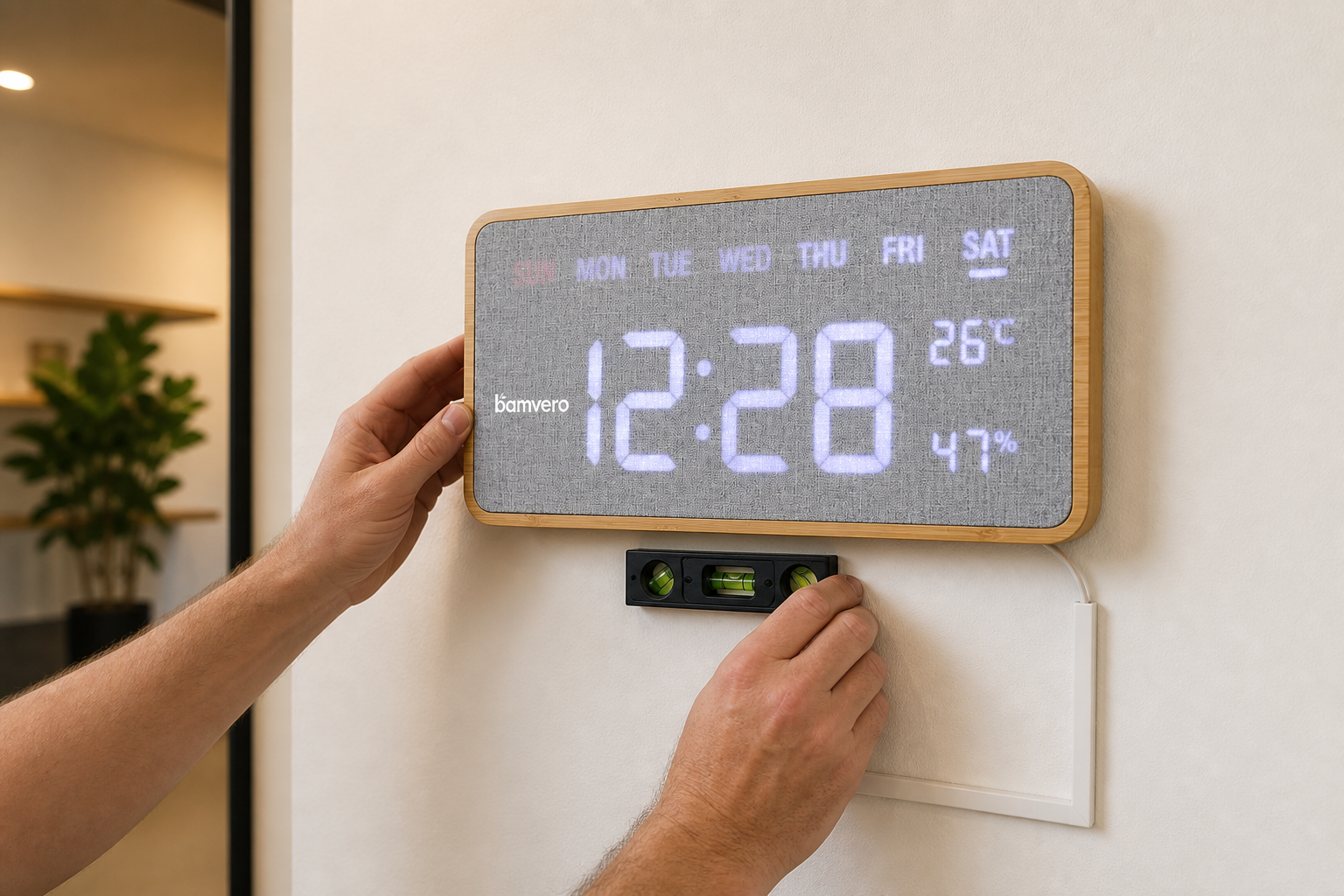
Bamboo Wall Clock Wholesale: Size, Power and Installation Planning
Compare real product proportions, display formats, power routes and mounting needs in the intended room before approving a wall-clock sample.
Plan the Placement Before Choosing a Model

A wall clock is part of the room, not only a product on a specification sheet. Wholesale buyers should define the viewing distance, wall material, nearby power route and surrounding furniture before selecting a shape or display style.
Start by comparing the real product proportions of the G290 rectangular bamboo fabric wall clock with the intended retail or commercial setting. A product that looks balanced in a close-up image may feel too small or visually heavy on the actual wall.
Match Display Format to Viewing Distance

Review the clock from the distance people will normally use. A buyer sourcing for offices, reception areas, meeting rooms or hospitality spaces should test character size, contrast and reflections under the room lighting.
Different outlines change how a display is perceived. Compare a rectangular format with the G218D round bamboo LED wall clock rather than assuming the same display will read equally well in every housing.
Confirm Power and Cable Management
Ask how the selected model is powered and where the connector sits. The sample review should include the intended cable route, adapter location and any channel or cover needed to keep the installation tidy.
Do not approve only a front-view photograph. Inspect the back, connector access and mounting area, then test the complete power setup on a representative wall. Record the approved cable and adapter with the product revision.
Check the Mounting Method Against the Wall

The correct mounting solution depends on product weight, fixing points and wall construction. Buyers should obtain installation dimensions and use a qualified local installer where required instead of treating one generic hook as suitable for every site.
Use the actual sample to confirm level, clearance, cable bend and access for future removal. A round option such as the G292B bamboo LED wall clock may need a different visual alignment check from a rectangular housing.
Compare Bamboo and Fabric Surfaces in Context

Bamboo grain and tone naturally vary, while fabric panels respond differently to light and dust. Define an acceptable finish range using several representative units and view them under the lighting of the target environment.
For fabric-front formats, check weave direction, tension, edge alignment and contrast around the display. The G218A bamboo fabric wall clock provides another reference when comparing natural bamboo edges with a softer front surface.
Protect the Product for Wholesale Shipping
Wall-clock packaging needs to protect the visible face, corners, mounting area and electronic components. Request a completed unit pack and check whether the product can move or rub during parcel and master-carton handling.
Record unit-box dimensions, gross weight, carton quantity and accessory location from the finished pack. The bamboo clock packaging and master carton guide explains why freight comparisons should use measured packing data rather than an early estimate.
Prepare Clear Installation Instructions
Instructions should identify the mounting points, approved power accessories, cable route, setup sequence and safe removal method. Use diagrams that match the exact model rather than a generic wall-clock sheet.
Retailers also need concise product-page information explaining what is included and what the end user must provide. Keep the website, manual, quotation and package contents aligned under the same model revision.
Approve a Small Installation Trial
Before a wider order, install the sample in one representative location and observe it for normal use. Check readability, clock settings, cable appearance, stability and the effort required to clean or remove the product.
Send Woodshowtime the target room, viewing distance, wall type, power situation, preferred outline, quantity and branding needs. Those details support a focused model shortlist and a sample plan based on the real installation rather than appearance alone.
Build the specification before comparing the final price.
Align the target channel, product functions, destination market, branding and packaging route before approving a sample or bulk quotation.